
Skip to content

Earlier visibility, while there is still time to use it.

Create earlier visibility into engagement, comprehension, learning behavior, and the pathways students are actually on — for the adults who are already trying to see them.
Environment
Secondary schools and districts
Emphasis
Earlier visibility
Governance
District policy and consent
Status
Research and development

In a high school, the people closest to a student usually notice something before any system does. A teacher senses disengagement. A counselor hears something in a conversation. The difficulty is that these observations are informal, unconnected, and easy to lose across six teachers and a full timetable.

Artifact is researching how the naturally occurring signals of a school day can be structured well enough to be shared — carefully, and with appropriate governance — between the adults responsible for a student's support.

Signals in this environment

  • Comprehension
  • Confusion
  • Interest
  • Participation
  • Momentum
  • Attendance
  • Course sequence
  • Support contact

Who this is for

  • AdministratorsSchool and district-level patterns
  • TeachersComprehension inside their own classrooms
  • CounselorsEarlier and more specific context
  • StudentsUnderstanding of their own learning
  • FamiliesMeaningful visibility, where appropriate

The questions worth answering here.

These are the questions institutions in this environment bring to us most often. Artifact does not claim to answer any of them completely — it makes the conditions surrounding them visible earlier.

Late signal

A grade at the end of a marking period is a summary of conditions that were in place weeks earlier. Comprehension signal describes those conditions while they are still current.

Fragmented observation

Six teachers each hold part of the picture, and no structure exists to assemble it. The pattern is often visible only in the aggregate no one can see.

Engagement, not compliance

Attendance and completion measure compliance. Whether a student is actually engaging with the material is a different question, and a more useful one.

Support routing

Support is finite. Understanding where it would make the most difference is a decision counselors make constantly, usually with incomplete information.

Pathways

Course selection and program choices compound over four years. Making those trajectories visible — as options rather than tracks — is one of the most consequential things a school can do.

Transitions

The moves between grade levels, schools, and post-secondary destinations are where context is most often lost, and where it would be most valuable.

Where the intelligence layer starts.

What a bespoke operating system for this environment tends to focus on first.
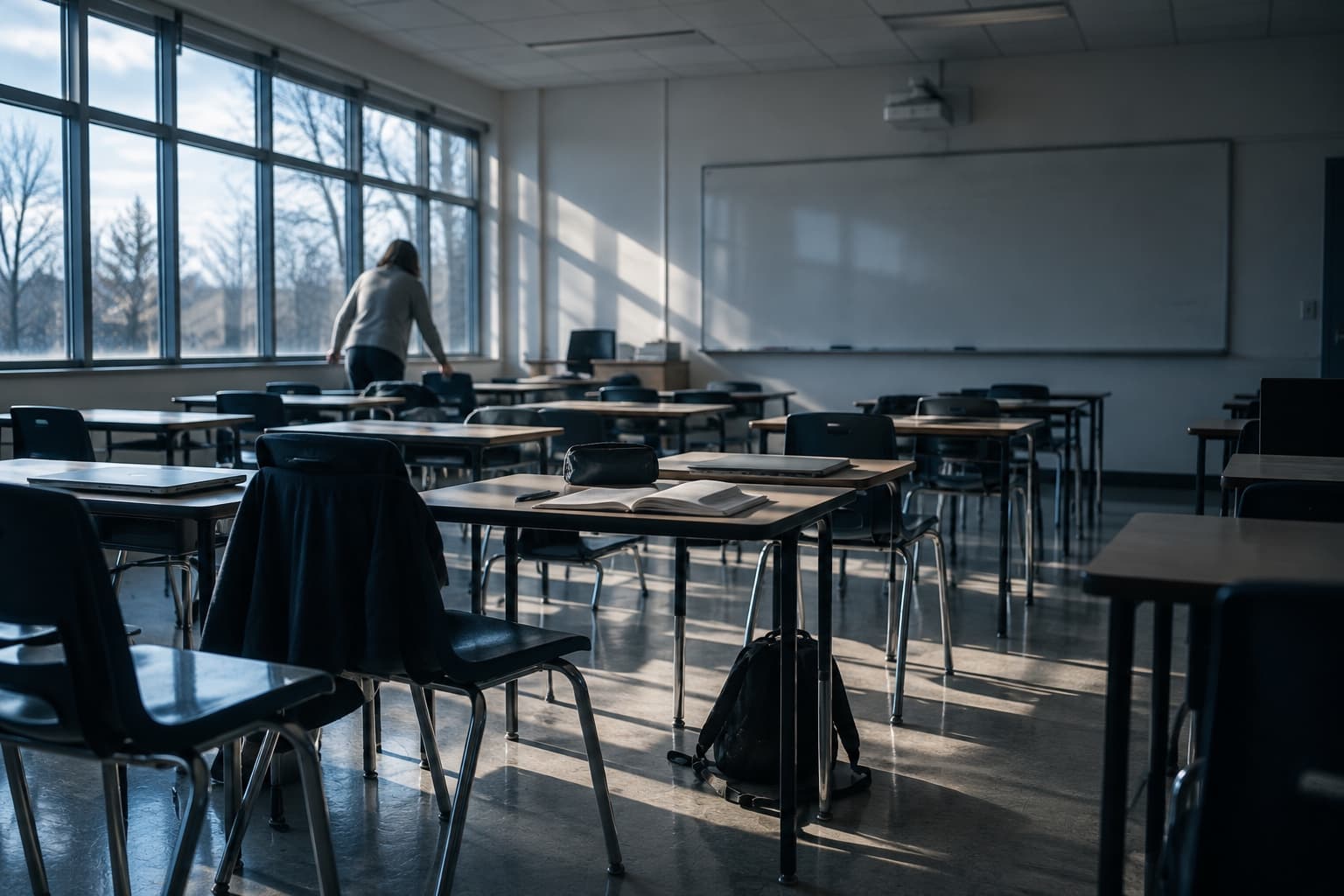
A secondary classroom between sessions: desks and chairs in cool afternoon light, a jacket over a chair back, and a teacher at the windows with their back to camera.
01

Classroom comprehension

Lightweight signal a teacher can read the same week, anchored to the concept rather than the assignment.
02

Cross-classroom view

A student's experience assembled across their full timetable, so a pattern visible in three rooms is not missed in any one of them.
03

Counselor context

Earlier, more specific context for conversations that would otherwise begin with a grade report.
04

Pathway visibility

How course sequences and program choices open or narrow what is available later — surfaced while the choices are still ahead.

Experience to outcome, in this environment.

The same movement, applied to this environment's own signals, systems, and decisions.
  1. Experience

    A lecture, a lab, a seminar, a shift, a study session.

  2. Signals

    Comprehension, confidence, confusion, participation, momentum.

  3. Intelligence

    Relationships between behaviour, context, and outcome.

  4. Pathways

    Modeled trajectories with associated likelihoods.

  5. Outcomes

    Understanding, persistence, capability, institutional result.

Signals about minors carry a higher standard of care, not a lower one. Any high school deployment is governed by district policy, family consent, and strict purpose limitation — signals collected to support learning are architecturally separated from disciplinary processes. Where a school chooses not to extend visibility to families, the system respects that decision by design.

A small school counselling office between appointments: two soft chairs angled toward a low table with an open notebook, a plant and a box of tissues, daylight through a blind.

Every engagement is scoped around what an institution actually wants to understand — and around what it is prepared to do with the answer. Where an intelligence layer is not the right instrument, we say so.

What could your institution learn about itself?

Artifact Intelligence works with high schools environments exploring new ways to understand learning, behavior, knowledge, and outcomes.